 |
 |
|
 |
 |
 |
| Al di la della Luna; Beyond the Moon; Astrophotography; Astrofotografia; Danilo Pivato |
The Cooke equatorial refractor, mounted on a German-type support (Sons), is a remarkable exam-ple of 19th-century optical engineering. Its achromatic doublet objective lens, with an aperture of 39.4 cm and a focal length of 591 cm (f/15), affords both exceptional clarity and remarkable resolving power. The telescope rests upon a cast-iron column composed of three superimposed sections a solid base and two truncated-conical elements—allowing precise adjustments in azimuth at the joints and in latitude on the upper surface of the final segment. The telescope tube, extending 672 cm and fashioned from laminated steel, is divided into four sections plus a dew shield, all joined by cast-iron flanges. The first two sections taper gently in a truncated-conical form, while the third, cylindrical, attaches perpendicularly to the declination axis. The final section, also cylindrical but longer, houses the objective lens and dew shield, complete with a protective flap. Precision in measurement is ensured by the instrument’s finely engraved circles. The brass declination circle, silvered for legibility, spans 68 cm and is divided into 2,160 increments of 15 arcminutes each. Its vernier, subdivided into 40 divisions and read via a telescope-mounted microscope along the tube, allows the astronomer to discern angles with a precision of 1 minute and 15 seconds of arc. The bronze hour circle, similarly silvered and measuring 43 cm in diameter, is graduated in hours and minutes; its vernier, divided into 60 parts, permits readings with a resolution of one second through a microscope. During observations, the astronomer could effect delicate movements of the telescope while remaining at the eyepiece, using two knobs connected to micrometric screw mechanisms on the respective axes. The telescope was originally equipped with a constant-speed sidereal drive, now disabled, powered by a weight-driven system coupled to a centrifugal governor. An iris diaphragm, operable from the eyepiece end, further enhanced control over the intensity of incoming light. From an optical standpoint, the instrument was an unqualified success, producing images of extraordinary clarity and a resolving power that made it a premier tool for detailed astronomical observation. |
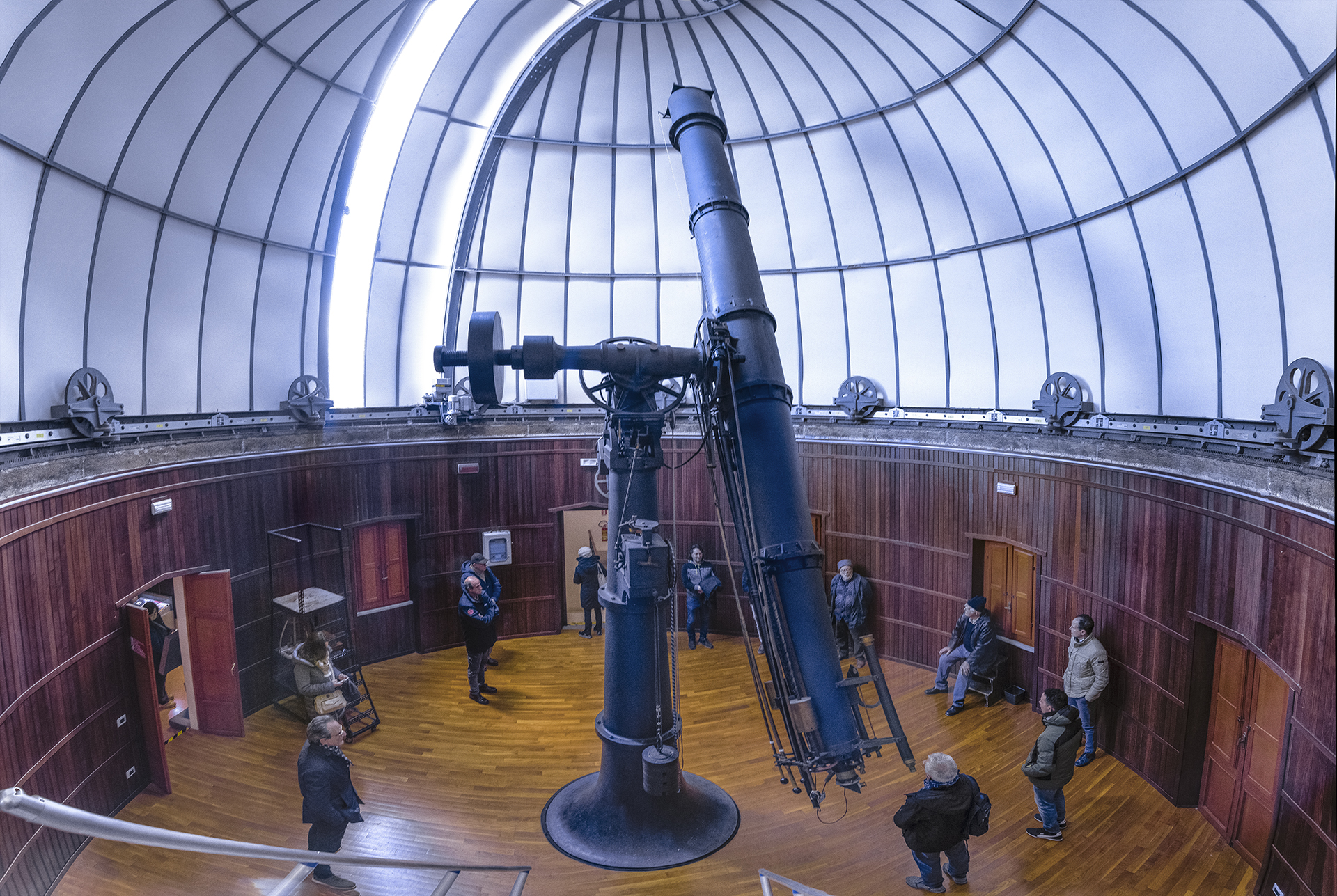 |
Photo: Danilo Pivato © Copyright: - Images & texts 2026 - All rights reserved